
Greece’s Golden Visa programme continues to attract international investors looking for European residency through qualifying investments. However, prospective property investors may need to consider an important proposed change to the cost of purchasing property.
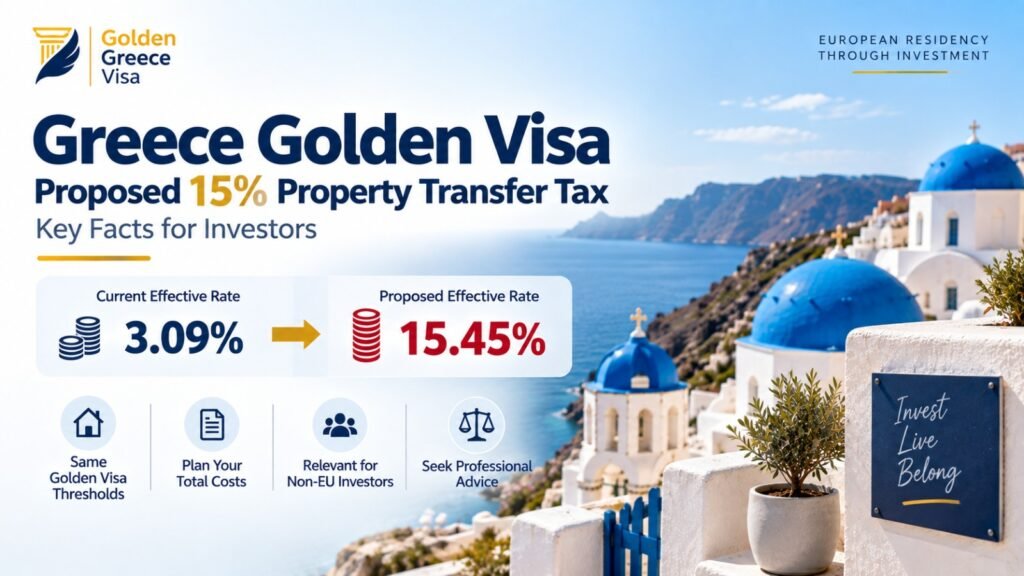
According to the source material, Greece has proposed increasing the headline property transfer tax from 3% to 15% for certain affected residential property purchases by non-EU/EEA buyers. Including the applicable municipal levy, the illustrative effective rate could increase from approximately 3.09% to 15.45%.
For Golden Visa investors, this distinction is important: the proposed 15% figure relates to property acquisition tax, not a 15% increase in the Golden Visa investment threshold.
The final scope, exemptions, implementation date and transitional provisions will depend on the legislation ultimately enacted.
What Is the Proposed Greece Property Transfer Tax Change?
Under the proposal described in the source material, the headline property transfer tax could rise from 3% to 15%.
When the applicable municipal levy is included, the illustrative effective rates are approximately:
- Current system: 3.09%
- Proposed regime: 15.45%
This could significantly increase the overall cash required when purchasing a qualifying property.
For example, on an €800,000 property, the illustrative additional transfer-tax burden is approximately €98,880, assuming for illustration that the purchase price and taxable value are the same. The actual tax payable in an individual transaction should be confirmed with qualified Greek legal and tax advisers.
Is the Greece Golden Visa Investment Threshold Increasing to 15%?
No.
One of the most important points for investors is to distinguish between the Golden Visa investment requirement and the cost of purchasing the qualifying property.
The source material identifies the current framework as including:
- €800,000 for designated high-demand areas
- €400,000 for other qualifying locations
- €250,000 for specified conversion and restoration opportunities
The proposed property transfer-tax change does not itself change these Golden Visa investment thresholds. Instead, it could increase the additional cash required to complete the property transaction.
Therefore, investors should not interpret the proposed 15% property transfer tax as a new Golden Visa investment requirement.
How Much Could the Proposed Tax Add to a Property Purchase?
The potential difference becomes clearer when applied to different property values.
Using the illustrative effective rate described in the source material, the potential additional amounts are:
| Property Value | Illustrative Additional Tax |
|---|---|
| €250,000 | +€30,900 |
| €400,000 | +€49,440 |
| €800,000 | +€98,880 |
| €1,000,000 | +€123,600 |
These figures are illustrative, rather than a calculation of the final tax payable for every transaction. The final liability can depend on the applicable legislation, taxable value, property classification, exemptions and transaction structure.
What Does the Proposed Tax Mean for Indian Investors?
The proposed measure could be particularly relevant for investors from countries outside the EU/EEA, including India, subject to the final legislation and any applicable exemptions.
For Indian investors considering the Greece Golden Visa, the potential property transfer tax should therefore be incorporated into financial planning from the beginning.
Instead of considering only the advertised property price, investors may need to calculate the complete acquisition budget, including:
Property price + transfer tax + legal fees + notarial costs + registration/cadastral charges + other applicable acquisition expenses.
This approach can provide a more realistic picture of the capital required to complete the investment.
What Remains Unchanged Under the Proposal?
Based on the source material, the proposed property tax change should be viewed separately from the underlying Greece Golden Visa framework.
The proposal does not itself change:
- Golden Visa investment thresholds
- Residency rights
- Family inclusion
- The broader residency-by-investment framework
The potential change primarily concerns the transaction cost associated with purchasing property.
This is why investors should carefully distinguish between the amount required to qualify for the Golden Visa and the total amount required to purchase and complete the qualifying property transaction.
What About the €250,000 Greece Golden Visa Route?
The €250,000 option requires particular attention.
It is not a blanket permission to purchase any residential property for €250,000. According to the source material, this route relates to specific qualifying situations, including certain non-residential properties converted to residential use and eligible restoration projects.
Consequently, the legal classification and structure of the property are important.
Investors should not assume that a property marketed as a conversion opportunity will automatically qualify for the same treatment. The property’s classification and transaction structure should be reviewed before funds are committed.
Why Could the Proposed 2027 Change Matter?
If the proposed regime becomes effective in 2027, the transfer-tax burden associated with an eligible purchase could potentially be substantially higher than under the current system.
For an €800,000 purchase, the source material illustrates a difference of almost €99,000.
This makes preparation particularly important for investors who are already considering a qualifying property.
A transaction may require time for:
- Property selection
- Golden Visa eligibility checks
- Legal due diligence
- Tax planning
- Contract preparation
- Payment arrangements
- Property registration
- Golden Visa documentation and processing
However, a potential tax saving should not be the only reason to rush into a property purchase. The suitability of the property, its legal status, investment potential and overall financial structure should also be evaluated.
How Could Higher Acquisition Costs Affect Investment Returns?
A higher acquisition cost can affect more than the initial budget.
For property investors, additional transaction costs can influence:
- Rental yield
- Expected investment return
- Capital allocation
- Exit strategy
- Overall investment economics
- Comparison with alternative European residency programmes
The impact can also vary depending on the type of property being considered. Standard residential properties, commercial properties and qualifying conversion or restoration projects can have different legal and tax considerations.
For this reason, investors should evaluate the complete investment structure, rather than comparing properties based solely on their advertised purchase price.